Rebuilding Gaza

Donate to Aid for Mankind
Select Cause
- --Select Cause--
-
 Zakat
-
Lilah
-
Sadaqah
-
General
Gift Aid Boost Your Donation
Gift Aid is reclaimed by the charity from the tax you pay for the current tax year. Your address is needed to identify you as a current UK taxpayer.
I want to Gift Aid my donation and any donations I make in the future or have made in the past 4 years to Aid For Mankind. I am a UK taxpayer and understand that if I pay less Income Tax and/or Capital Gains Tax than the amount of Gift Aid claimed on all my donations in that tax year, it is my responsibility to pay any difference.
Last updated: Monday 7 September 2026.
In 60 seconds
- A ceasefire has been in force in Gaza since around October 2025, and on 30 July 2026 Hamas and the US-led Board of Peace announced agreement on a disarmament roadmap for the next phase of the plan.
- That roadmap is stuck on sequencing: Hamas says it will not disarm until Israel halts attacks and withdraws its troops, while Israel and the Board of Peace say there will be no withdrawal until Hamas disarms.
- On 29 August 2026 the Board of Peace's top envoy, Nikolay Mladenov, warned Gaza risks being "gone for good" without reconstruction, withdrawal and demilitarisation moving forward together.
- Day to day, water remains the sharpest problem: around 90% of people report frequent, unpredictable disruptions to safe water, rising to 92% in Gaza City (UN-cited survey, July 2026).
- Gaza's Health Ministry reported 73,651 Palestinians martyred and 174,592 wounded since October 2023, as of 6 September 2026, a ministry-reported figure rather than an independently verified count.
Latest: 4 to 7 September
- Palestinians in northern Gaza buried the remains of about 100 people, including around 60 children, recovered from rubble in Gaza City's Zeitoun neighbourhood (Al Jazeera, 6 September 2026).
- Gaza's Health Ministry said at least 73,651 Palestinians have been martyred and 174,592 wounded since October 2023, a ministry-reported figure rather than an independently verified count (Al Jazeera, 6 September 2026).
- Foreign ministers of Saudi Arabia, Jordan, the UAE, Turkiye, Qatar, Egypt, Indonesia and Pakistan jointly condemned Israeli ministers' plans to promote Palestinian "emigration" from Gaza as a violation of international law (Times of Israel, 6 September 2026).
- The UK foreign secretary said children in Gaza are dying while waiting for medical treatment and that Israel is blocking medicine; Israel and the US ambassador to Israel disputed the claim (Times of Israel, 6 September 2026).
- The United States rejected Israeli suggestions of removing Palestinians from Gaza, after Israeli ministers floated "voluntary emigration" plans (Al Jazeera, 4 September 2026).
The October 2025 ceasefire remains formally in place but fragile, with sporadic strikes and raids reported, and no announcement from either side or the Board of Peace that it has ended.
This page sets out, plainly and with sources, what is actually happening in Gaza right now: what was agreed in the peace process, what remains stuck, and what daily life looks like for people still living through it.
The disarmament deal: what was agreed, and what is stuck
On 30 July 2026, US President Donald Trump announced what he called a "historic agreement" under which Hamas agreed to disarm in stages. The announcement followed talks led by the US-backed Board of Peace and the International Stabilization Force for Gaza, with mediators from Egypt, Qatar, Turkiye and the United States finalising a roadmap for the next phase of the wider ceasefire plan (Axios, 30 July 2026). Under that roadmap, a detailed disarmament timetable was due to be prepared within 14 days, with possible extensions subject to sign-off by an international verification body and agreement of all parties (Al Jazeera, 31 July 2026).
Since then, the deal has not moved forward as planned. Hamas negotiator Ghazi Hamad said Hamas would not implement any part of the agreement unless Israel first met its own obligations, including halting attacks and withdrawing troops (Al Jazeera, 4 September 2026). Israel's position runs the other way: a spokesperson for Prime Minister Benjamin Netanyahu's office said Israeli forces would not withdraw until Hamas was fully disarmed, and on 4 August 2026 the Board of Peace itself stated there would be no Israeli withdrawal from Gaza before Hamas disarms (Al Jazeera, 4 August 2026). It also remains unresolved whether Palestinian armed groups other than Hamas will disarm under the agreement, and whether Israeli forces will in practice fully withdraw (Al Jazeera, 31 July 2026).
Friction on the ground has continued alongside the political stand-off: 29 ceasefire violations were reported between 19 August and 3 September 2026, alongside a report that Israeli forces captured a Hamas security chief (FDD Overnight Brief, 4 September 2026).
"Gone for good": the warning from the Board of Peace
On 29 August 2026, Nikolay Mladenov, the top envoy for the US-led Board of Peace, warned that Gaza was at risk of being "gone for good" unless reconstruction, an Israeli withdrawal and demilitarisation proceeded together. He said deteriorating conditions on the ground could trigger a fresh security crisis (Al Jazeera, 29 August 2026; Muscat Daily, 29 August 2026). It was not the first time he had linked the ceasefire's survival to the disarmament dispute: back on 13 May 2026, Mladenov said the ceasefire's durability hinged on Hamas disarmament, an early public statement of the same sequencing argument that was still unresolved come September (Al Jazeera, 13 May 2026).
Read together, these statements describe a peace process that is real and has held for almost a year, but that has stalled on exactly the question both sides needed to answer to move forward: who moves first.
What life is like right now
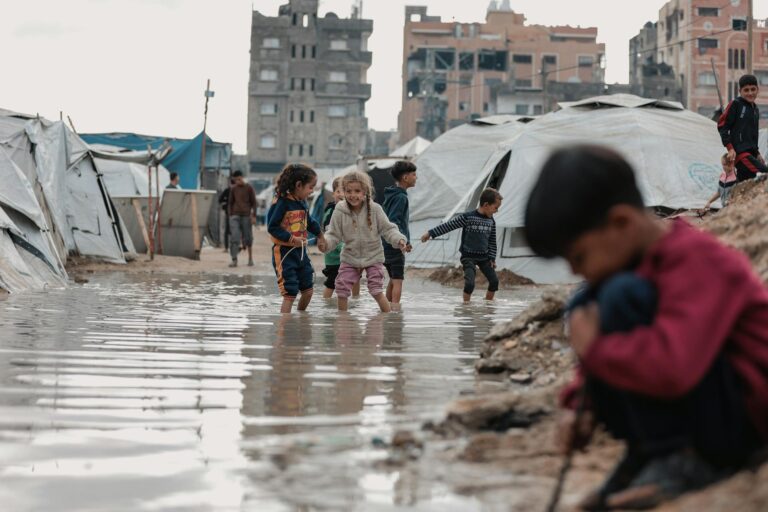
Water. A UN-cited survey found that 90% of Gaza's population reported frequent, unpredictable disruptions to safe drinking, cooking and hygiene water in early July 2026, rising to 92% in Gaza City (Al Jazeera, 1 September 2026). Around 75% of the population still relied on trucked water as their primary drinking source at the end of July 2026. Humanitarian partners were delivering more than 20,000 cubic metres of water a day to collection points, and UNICEF and partners were trucking water from desalination plants at an extra cost of around USD 40,000 a day, to replace roughly 2 million litres a day previously collected from the Al Mansoura site (Al Jazeera, 1 September 2026). Altogether, more than 70,000 cubic metres of water a day were being supplied to Gaza through pipelines, desalination and other infrastructure over the same period (Al Jazeera, 1 September 2026).
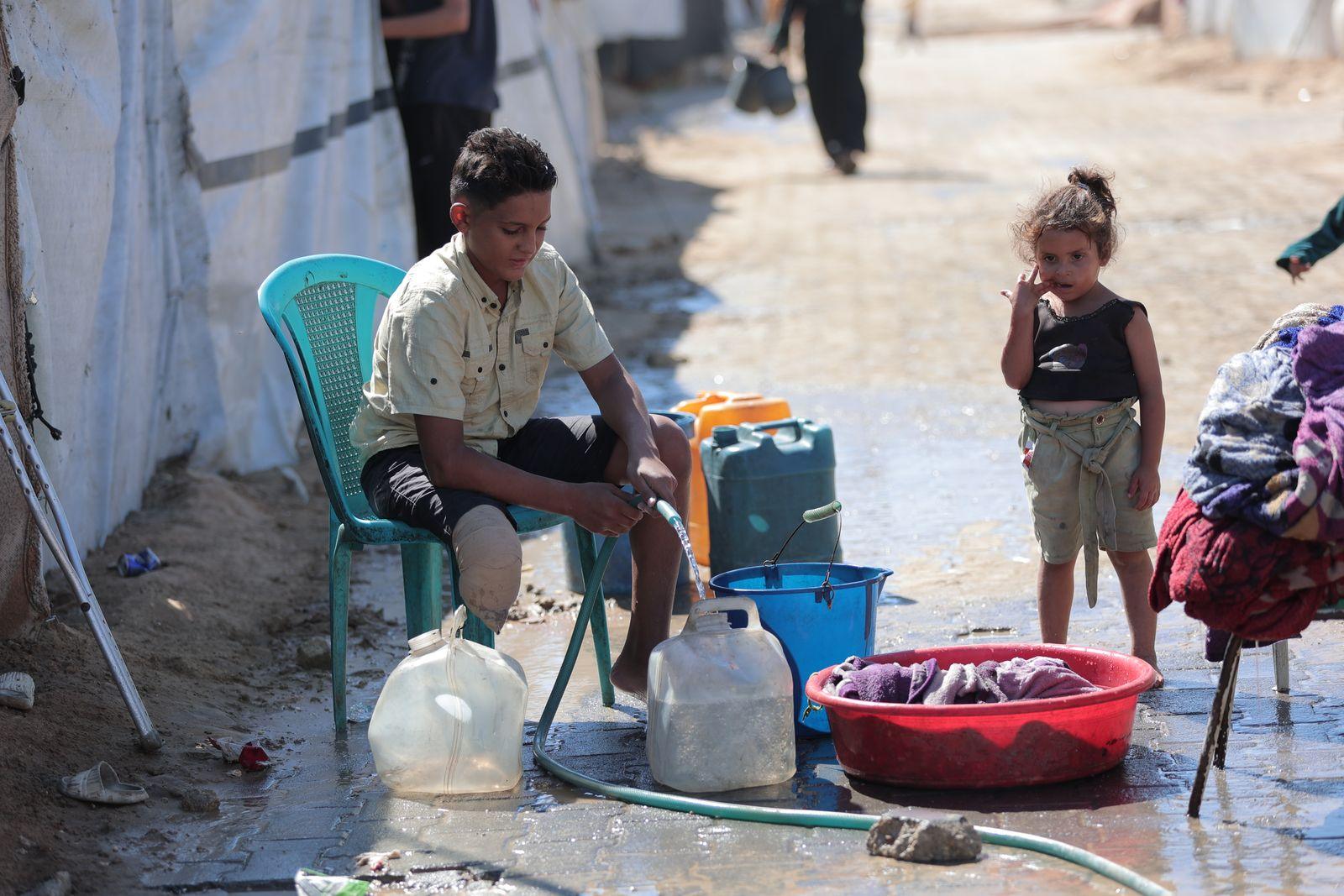
Photo: Hosny Salah via Pexels
Medicine. Officials at Gaza's Al-Aqsa Martyrs Hospital say cancer medicines have completely run out amid continuing Israeli strikes, with cancer and haematology drug shortages reaching around 61% at the facility - a shortage that hospital staff described as leaving oncology patients at "imminent risk of death" (reported August 2026, and QNA, 1 August 2026). Two of the hospital's four medicine warehouses were completely destroyed and the other two severely damaged in early August 2026, according to Gaza's Ministry of Health (Peninsula Qatar / QNA, 1 August 2026).
Shelter. Around 1.5 million Palestinians have had their homes destroyed, with around 80,000 displaced people living in formal shelter centres and hundreds of thousands more nearby or near destroyed homes, according to figures reported in January 2026 (UN News, January 2026). Around 800,000 people were living in locations prone to flooding (UN News, January 2026). Gaza's population faced a third consecutive winter of widespread displacement in worn-out tents that tear easily in rain and wind, with UNRWA reporting at least 12 fire incidents in shelters since November 2025 (New Arab feature, winter 2025-26 reporting). Between 4 and 10 February 2026, the Shelter Cluster reached almost 5,500 households with 1,730 tents and 1,420 tarpaulins, though distributions had fallen due to lengthy approval processes and access restrictions (OCHA Gaza Humanitarian Response Situation Report No. 67).
The human cost. Gaza's Health Ministry put the cumulative death toll at 73,651 people martyred as of the morning of 6 September 2026, with 174,575 people reported wounded since October 2023 (Palestine Information Center, 5 September 2026). This is a figure reported by Gaza's Health Ministry rather than an independently verified count, and it is presented here on that basis.
Against this, there is one piece of genuinely better news: OCHA reported in its 31 July 2026 update that acute malnutrition had declined significantly, attributed to a scale-up of nutrition programmes made possible by improved access after the October 2025 ceasefire (OCHA, 31 July 2026).
What happens next
The peace plan itself is not in doubt: it was formally endorsed by the UN Security Council on 17 November 2025 through Resolution 2803, passed 13-0 with Russia and China abstaining. What is in doubt is timing and sequence. Until Hamas and Israel resolve the same dispute that has run since May 2026 - who moves first, disarmament or withdrawal - the roadmap agreed on 30 July 2026 cannot move into full implementation. Mladenov's warning on 29 August 2026 makes clear that the Board of Peace itself sees the situation as urgent rather than settled: further delay risks the reconstruction and stabilisation of Gaza becoming permanently harder to achieve.
How you can help today
Whatever happens next in the political process, the water and medicine needs described above are immediate. Aid For Mankind runs a desalination-based clean water response for Gaza, because the ground itself is too contaminated for a traditional well.